
Health & Safety Policy — Office Clearance Yeading
Statement of intent: This policy sets out the health and safety principles and practical controls that govern all office clearance and rubbish removal activities carried out by our team. The aim is to protect staff, contractors, clients and the public from harm during any form of commercial clearance, office junk removal or workplace declutter. We commit to preventing injury and occupational illness by applying robust procedures, continuous training and sensible risk controls. Safety is an integral part of every job, from initial assessment to final waste transfer.This policy applies to all Yeading office clearance operations, including small-scale office tidy-ups and larger commercial clearance projects. It clarifies responsibilities for managers, site supervisors and operatives, and sets expectations for safe working methods, equipment care and environmental stewardship. The document covers manual handling, hazardous materials, site access, vehicle safety and the segregation of recyclables and general waste. Where subcontractors or temporary workers are used, they will be required to work to the procedures described here.
 Responsibilities: Senior management will ensure resources, training and oversight are provided. Site supervisors must conduct briefings and maintain safe systems of work; operatives must follow instructions, report hazards and use personal protective equipment. Key duties include regular risk assessments, safe lifting practices, proper use of tools and machinery, and secure loading of vehicles. Everyone is encouraged to raise concerns promptly so that prompt corrective action can be taken.
Risk assessment and control measures
Risk assessment is central to safe office clearance work. Each job will be assessed before operations begin to identify hazards such as sharps, asbestos-containing materials, flammable liquids, unstable stacks of furniture, trip hazards, and vehicle movement. Controls will be proportionate and include:- use of mechanical aids and team lifts for heavy items
- segregation of hazardous waste and specialist disposal routes
- barriers and signage to protect the public
- regular inspection of tools, trolleys and lifting equipment
 Personal protective equipment (PPE) and training are mandatory. Operatives are issued with gloves, high-visibility clothing, steel-toe footwear and appropriate respiratory protection where dust or fumes may be present. Training covers manual handling, safe use of knives and pallet trucks, driving and reversing safety, and awareness of hazardous materials. Competency is verified for specialized tasks such as working at height or handling controlled wastes.
Traffic management plans are developed for locations where vehicles operate close to pedestrians. Loading and unloading procedures minimize manual handling and secure loads to prevent shifting during transit. For large commercial clearance and office removal services, vehicle maintenance and driver checks are recorded to ensure roadworthiness and compliance with operational safety standards.
Operational procedures for clearance teams
Before work starts a site-specific plan is prepared, covering access points, storage areas, emergency exits and recycling routes. Operatives follow a clear sequence: assess, segregate, secure and remove. Waste hierarchy principles are applied — prioritise re-use and recycling over disposal. Correct labeling of waste streams and use of secure containers reduce contamination and help meet environmental objectives associated with commercial clearance services.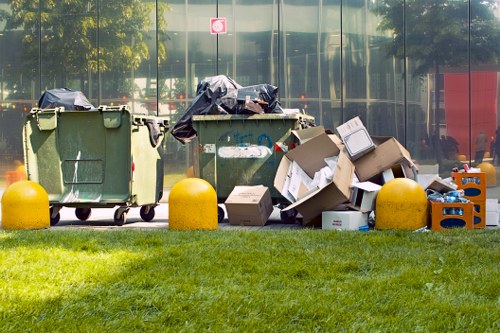 Contractors and subcontractors engaged to assist with office clearing will be vetted to ensure they operate to equivalent safety standards. Equipment maintenance records, insurance confirmation and proof of training will be checked. All teams must participate in toolbox talks and sign off on site-specific risk assessments before starting. This ensures consistent standards across every job, from single-room office clear-outs to multi-floor corporate refurbishments.
 Monitoring, incident reporting and continuous improvement: All incidents, near misses and unsafe conditions must be recorded and investigated to prevent recurrence. Regular audits, spot checks and management reviews maintain the standard of safety during rubbish collection and removal operations. Performance indicators include incident frequency, completion of risk assessments, PPE compliance and timely maintenance of vehicles and equipment. Continuous improvement is driven by lessons learned and by adapting procedures to emerging risks.
Emergency arrangements include clearly defined routes for evacuation, access for emergency services and readily available first aid provisions on site. Operatives are trained in basic first aid and in procedures for dealing with spills, sharps or suspected hazardous materials. Fire safety includes suitable extinguishers, ignition source control and no-smoking practices within active clearance zones.
Record keeping and documentation are maintained for all projects: site assessments, method statements, training logs and incident reports are retained for review. Insurance and compliance records are kept up to date without reference to local legal specifics. Data is used to drive improvements in operational safety and to demonstrate due diligence in health and safety management for office clearance and waste removal operations.
Policy review: This health and safety policy is reviewed periodically to reflect changes in operations, equipment or industry best practice. Senior management endorse the review process and commit to providing necessary resources. The collective aim is a safe working environment where every clearance job — whether rubbish removal, office clearance, or commercial site tidy — is carried out safely, efficiently and with respect for people and the environment.
